Test image post


Posted 2026-XX-XX


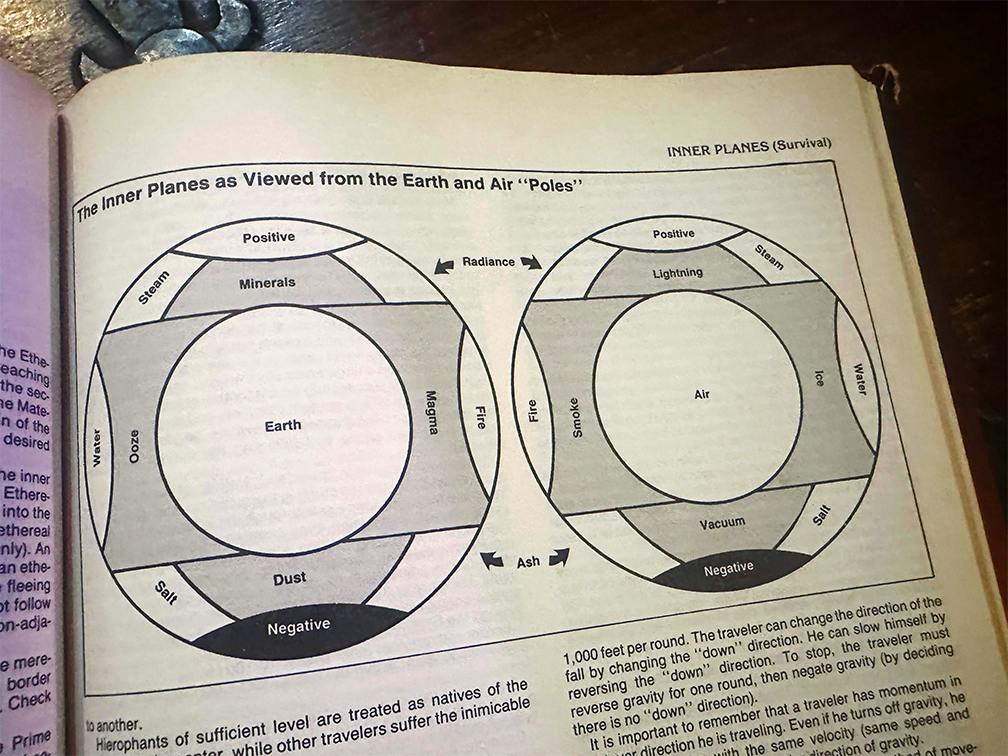
I think D&D's elemental planes (as I recall them from the old Manual of the Planes, anyway) are simultaneously too alien to be easily gameable and too boring to be worth the effort. Reworking them into more survivable, comprehensible places that express and exemplify their elements rather than just being wholly composed of them could be cool.
(Yeah, I'm sure they already fixed this in later editions. I kinda never absorbed setting fluff past 2e, though. My head is full of TSR-era lore and WotC-era rules. So I'm gonna just do this myself and pretend it's original.)
It might be even cooler to scrape off their serial numbers and ditch the idea of an orderly pseudo-Medieval/Classical elemental cosmology all together. So, instead of that fiery world being the Elemental Plane of Fire (where all of the fire-themed monsters live), it's just a fiery alien world which can have characteristics and relationships outside of that whole symmetrical paradigm.
For that matter, this idea could also be applied to "elements" that aren't in the AD&D elemental / para-elemental / quasi-elemental list. You know, like a blood plane or a sword plane. And it might even work with some of the Outer Planes! At least some of those actually have totally cool presentations that are only held back by the mythological mishmash of their names and the unnaturally orderly, alignment-centric cosmology of the Great Wheel.
...But I've got plenty to think about with the regular elemental planes, so let's see if I can do anything cool with them.
The Plane of Air is already the most survivable and gameable elemental plane, and it's frankly not even that boring! I'd leave this almost unchanged.
It's a big, air-filled space with loads of floating motes of various sizes, some stationary and some orbiting other objects. Gravity is kind of local, so that small islands have way more pull than you'd expect, but you can still jump from them and shoot into the void. The whole place is lit and warmed by loads of little suns of various colors, so some amount of light is pretty much everywhere all the time. It's also really colorful: The distance haze effect isn't always blue, depending on local conditions, and nebulae of various hues stretch across the sky.
Life here looks a lot like that of Earth's pelagic zone, so loads of things like huge fish, arthropods, and cnidarians swim through the air. Loads of them are transparent, even nearly invisible, and they tend to have great vision (even the jellyfish analogs). Island life varies locally, since it can be very isolated. Plants are everywhere, but small islands might have very little animal life. There are also trans-island animals (like birds and flying insects) that mostly live on islands but can flit between them.
This is another plane where the original portrayal wasn't bad, but just kind of not enough. Instead of just occasional vacuoles of air, this plane needs to be honeycombed with tunnels!
So let's say the plane is a vast expanse of stone, all in various uneven strata, and possibly including some fantastic materials. Gravity is constant and Earth-like, and there's a universal "down". There's plenty of heat from magma and gas fires, so some areas are warm or even hot, but others can be damn cold. There are loads of vast caverns full of air and life. These typically have a layer of fertile soil at the bottom, and some are lit by sun-like orbs of flame, while others are dark. They're connected by smaller natural caves, mazy tunnels left by eons of burrowing creatures, and even hallways, shafts, and staircases created by intelligent beings.
Most life forms tend towards huge, worm-like burrowers and smaller invertebrates that live in the tunnels and debris they leave behind, both categories tending to be blind. The big caverns, however, have very distinct ecosystems: The lightless ones feature the powerful eyes and bioluminescence of Earth's abyssal sea creatures, while the sunlit caves have moss forests and much more surface-like animals.
The Fire Plane is probably the worst one in the Manual of the Planes. I could seriously never imagine it in a way that really worked for me.
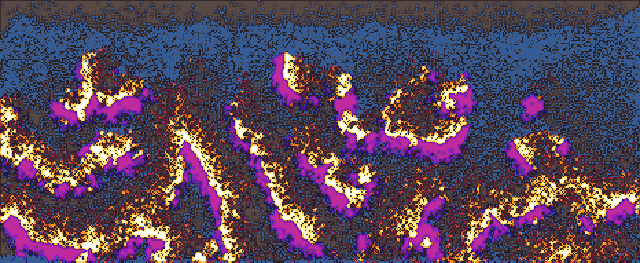
Instead of an infinite volume of Just Fire, Only Fire, In All Directions, we've got a vast plain. Some percentage of the plain is always on fire, but these fronts move endlessly, consuming regions of dry grass, brush, and scrubby little trees, and leaving behind a layer of fertile ash, already sprouting new growth. From a great distance above, the burning plain would look like one of those falling sand games where some short-lived, self-propagating element with a name like "virus" or "???" has gotten loose, sweeping over everything in chaotic but ultimately balanced waves.
There are some places on the plain that burn forever, because they're flaming pools of petrochemical sludge. Maybe there are occasional lava eruptions, too. And there are places that never burn: bodies of water, stretches of barren sand, and rocky ridges. Sometimes there's rain. Frequently, there are hot windstorms of sparks and ash. There's no sun in the sky, but there's never any lack of light or heat.
Life on this plain is mostly small, swift animals—things analogous to mice, grasshoppers, sparrows, etc.—and small, fast-growing plants. Lots of animals (especially the larger ones) are burrowers. The lakes hold remarkably ordinary fish and amphibians. The intelligent inhabitants build underground, or in the sandy and rocky places.
An infinite volume of water is less interesting than a vast sea with an actual surface. With a surface, you can have boats and islands and storms. So this plane has a surface. No bottom, though. You can just dive down and down and down, getting darker and colder, the pressure increasing until the water becomes ice.
The depths are, of course, full of every imaginable kind of sea life. There are even coral reefs of a sort, despite the lack of a sea floor: Neutrally-buoyant detritus like algae masses and giant mollusk shells accrue layer after layer of sessile life as they drift and bob through the water.
Something similar happens on the surface, too: Floating islands form by accreting around tangled forests of buoyant trees and algae mats, potentially extending miles in diameter and gathering thin strata of soil. These islands develop their own quasi-terrestrial ecosystems, birds being especially prevalent.
The intelligent inhabitants (the air-breathing ones, anyway) build on the islands and construct sprawling raft cities, as well as boats of every size and description. They're never wholly safe from the leviathans of the deeps, nor the plane's monstrous storms.
Like a nightmare vision of Antarctica and its surrounding sea: a patchy mix of jagged mountain ranges, dramatic ice formations, bleak snowfields, and mazes of ice-crusted water, extending endlessly in all directions. The weather is characterized by relentlessly howling wind and the occasional obliterating snowstorm. There's no real sun in the sky, just an infinite and monotonous flat whiteness.
There's barely a scrap of plant life, and few animals either—more under the icy surface of the water than on the snowy land. There are some shockingly large and dangerous animals, though: giant white bats, tusked whales, shaggy carnivorous anthropoids, amphibious sharks, wolves the size of polar bears. The few people living here are hardy, practical folk who subsist primarily by hunting things that could easily kill them, given half a chance.
And somewhere in this icy waste—far from every settlement and planar gateway, but not far enough—there's an imprisoned horror. It's a dark mass of tentacles, massive and towering, frozen solid in the act of reaching skyward. It's more than half-covered in ice and snow, and it looks for all the world like a colossal statue of black stone until it's examined closely. It's something like the Thing or a shoggoth. Maybe it's the progenitor of every mimic and doppelganger. If someone were to so much as chip a piece off and take that fragment to a warmer, more populous world, the results could be cataclysmic.
I'm sorry to report that the best possible Plane of Magma has already been created, and it's the Nether from Minecraft. So I'm just going to riff off that.
This whole plane is an infinite volume of chaotically-arranged solid rock, molten rock, and surprisingly breathable air. It's hot as hell, but not as hot as the inside of a volcano. The pools and cascades of lava don't radiate heat quite the way they would elsewhere: They'll incinerate you on contact, sure, but you can stand pretty close without being cooked. Most of the solid stone here is porous red-brown stuff with an extremely high melting point, but alarmingly brittle and friable. There are also familiar volcanic materials like basalt and obsidian, great drifts of dark ash, crystal formations that emit a dirty orange light, and deposits of minerals that are combustible or even explosive. That's one of the most perilous things about this place: Sometimes, a big chunk of rock somewhere will just explode, shattering lots of the fragile red stone, causing a nearby lava flow to be redirected.
Of course, there's life even here: sessile chemotrophs, metallic geovores, even things that generate energy from heat gradients. Most of it looks vaguely like abyssal ocean life: lots of worm-like things, crab-like things, vague blobs. There are even blind, metal-skinned lava-swimmers shaped sorta like fish. Virtually all of these creatures are too alien and specialized to be interested in eating creatures from a more Earth-like world, but they could still be dangerous to be near.
There are intelligent inhabitants, too. They build sprawling fortresses from a dark purplish, heat-resistant composite material, and they're experts at manipulating magma for industrial and defense purposes.

I always figured the Para-Elemental Plane of Ooze was clearly supposed to be about mud, since it's essentially the transitional realm between Earth and Water. But the word "ooze" has a lot of more interesting meanings! Obviously, there's the whole class of amorphous D&D monsters. But there's also the mutagenic ooze of Teenage Mutant Ninja Turtles fame! Plus the whole not-unconnected category of slime-based toys from the 1980s to (I guess?) the present. (And apparently there's also ooze candy? And vape pens or something? And that makes me think about The Stuff, that goofy '80s horror movie about an addictive, parasitic, corrupting dessert food—which I still say is a much better concept than folks ever realized.)
Anyway. This place is a lumpy expanse of fractally bulbous structures, most of which are covered in puckered apertures that frequently weep—or gush, or erupt—various kinds of slime, sludge, and slurry. The structures are tough and rubbery, mostly brown, gray, or dull purple, often mottled. Everything here is some level of slippery and/or sticky. Below the surface, the terrain is a complicated network of sacs, vessels, membranes, and fluids, all pulsing and flowing like the viscera of a single immense creature. However, it's all an ecosystem of interconnected colonial organisms coexisting in a slow and complicated dance of shifting symbiosis, competition, and manipulation.
And much of this activity leads to the production and expulsion of various goopy semisolids. These materials tend towards the green-yellow-orange-red part of the spectrum, and vary in viscosity from mucosal to gelatinous. Many are caustic, edible, narcotic, mutagenic, or some combination of those traits. A few are luminescent, and some are even animate.
In some places, whole expanses of surface material have died—the mark of microbiological wars decisively lost. These areas dissolve into soft, deflated films of tissue, and will easily split to dump a careless traveller into the internal muck.
The slime-spewing terrain isn't the only life here. There are loads of bird-like things that sip nutritious effluents (or tear chunks from the outer skin) while avoiding dangerous emissions, colonies of newt-lizard things that live in slime that would dissolve other creatures, huge worms that hollow out dripping homes in the surface structures. The intelligent inhabitants have learned to manipulate the oozes both chemically and ecologically, practicing a kind of living alchemy.
The brownish sky is lit by vast, roaming, sun-like orbs of white fire. They cruise high above the slimy world, disturbing the firmament into fluid psychedelic whorls as they pass. There are enough of them that any given point of the surface will effectively be in twilight most of the time, rarely fully lit, and almost never fully dark.
Generally, the most interesting thing smoke can do is deliver psychoactive chemicals to a body. I guess a distant second would be its role in "smoke and mirrors" obfuscation and trickery. And then we've got incense smoke and signal smoke kinda tied for third place.
So, this plane's terrain is mostly gently rolling hills covered in forests of thin, graceful trees and sparse grass. The foliage is shades of gray, dusty purple, and soft pink. Pale smoke simmers up through the dark earth from endless, naturally occurring pyrolysis of vegetable and fungal matter below—just a few thin wisps in most places, and great roiling gouts in a few. Very occasionally, crevasses and sinkholes open up, exposing the hot, soft depths and releasing clouds that are visible for miles.
The smoke's composition varies from one place to another, but it generally smells pleasant and resinous, very much like incense. When inhaled by non-native creatures, it can be disorienting, soporific, analgesic, euphoric, and even hallucinogenic. It's thickest close to the ground, so visitors that lie down in the forest risk falling asleep for so long that they die of dehydration (if they don't die of oxygen deprivation first). Creatures that fall into sinkholes are often paralyzed and slowly mummified, experiencing ecstatic visions all the while.
During the day, the sky is a bright silver-gray vault with the slightest rainbow pearlescence. At night, it dims to reveal stars like scattered jewels swimming in a shifting, distorting haze.
Local lifeforms are wholly or completely immune to the effects of the smoke. The animals tend towards familiar terrestrial types like mammals, reptiles, and birds, although often rather gracile and pastel-toned. There are also a number of remarkably large and wildly colorful invertebrates. There are very few burrowing creatures, due to the heat of the soil's burning layer.
The people here manage their smoke exposure by building their houses on stilts or in the trees. Wooden walkways are common, as well. They wear gas masks and goggles on long journeys or when they dig to unearth naturally carbonized charcoal. They know where safer and more useful smokes arise, and understand the subtle seasonality of their emission.
Okay, that's plenty for now. Maybe I'll do the quasi-elemental planes another time.
I definitely kinda got more into it once I got to the para-elemental planes, and the primary four seem underdeveloped in comparison. I'd definitely give those another pass if I was ever going to do anything with them.
I'd also rename everything, of course. But that's definitely an exercise for another time.
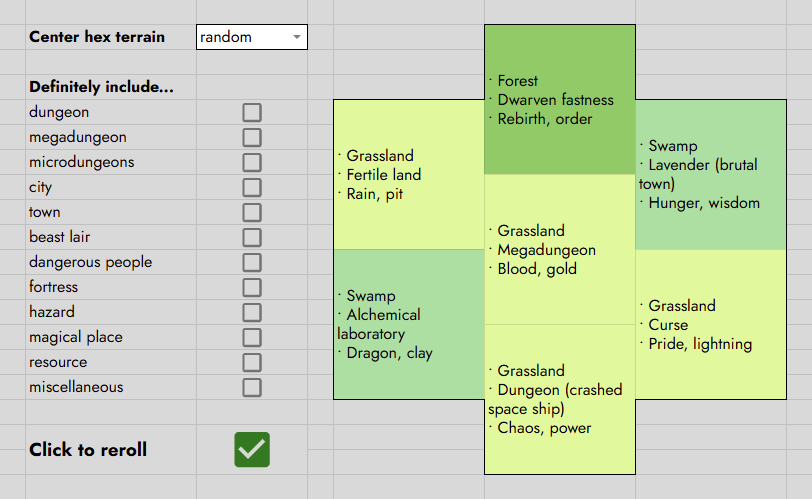
My Eastern Territories setting needs kind of a lot of development, so I reworked my tiny hex map generator into an Eastern-Territories-specific variant. In the process, I learned that I really do need more monsters and factions, and to come up with actual names for some of the setting elements I do have.
Anyway, it's enough to help me try out my basic conception of the setting. So, here's what I got on my first roll.
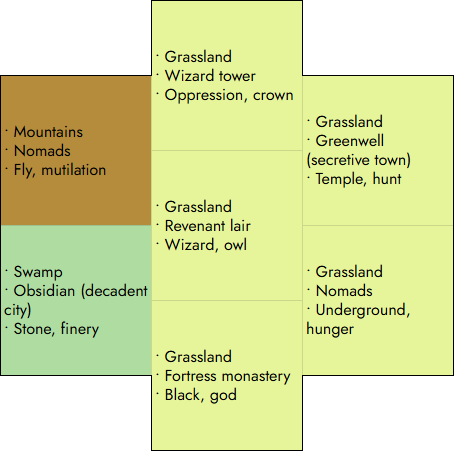
No dungeons at all! So naturally I'll interpret other locations as potentially dungeony. And I've got two hexes with "nomads", which I'm not necessarily interpreting as truly itinerant peoples, but maybe just extremely rural populations, and very possibly refugees from the general breakdown of the regional order.
I belatedly realize that I really should have set my center hex to "forest" instead of "random": The Eastern Territories are intended to be a pretty heavily wooded region. Oh well, I guess there are plains somewhere—especially to the north, where the land eventually transitions to savannah and desert.
Combining "wizard tower" with "oppression" and "crown", it's clear that I've got a wizard (or even a group of them) dominating and exploiting a local population, or even exerting power on nearby hexes. I really dig the idea of portraying this as a dire and toxic version of a magus covenant in Ars Magica.
There are several—say four or five—wizards here, and an equal number of non-magical companions (assorted warriors and experts, all PC-equivalent threats), plus a bunch of no-name guards and servants. Maybe they don't have a literal tower, but instead a big old house—something stony and gothic, but not quite a castle. Rambling with late additions and outbuildings, bristling with weathervanes, telescopes, and lightning rods.
The house—called the House of Thorns because it's choked with stinging ivy—dates back to the Empire of Flowers' never-quite-cemented conquest of the Eastern Territories, hosting a succession of imperial wizards, wealthy private sorcerers, and—most recently—teams of magicians from the School of Five Suns. Around that, there are a village and a few associated farms. The village grew up around the House of Thorns in the subsequent decades, so it never had a name of its own.
Maybe about a thousand people would live here in normal times, but the chaos in the Territories has caused people from the surrounding countryside to pull in towards it, and a few caravans of people fleeing petty wars have ended up here as well. The population is now at something like 1,200. Food will be a problem soon, and sanitation already is. But public order is largely not an issue, because the wizards have clamped down hard. They've distanced themselves from their Five Suns employers, they're ignoring the local powers that would call themselves the inheritors of imperial authority, and they've openly declared sovereignty over the village and everyone in it.
Now, unrestrained by school or empire and seeing warlords and worse impinging on all sides, the House of Thorns wizards are indulging in increasingly unethical experiments to secure their power, and the villagers and refugees are being treated as raw material.
These mountains are home to an outcast tribe of territories folk. They call themselves the Attibus family. They became an embittered pariah clan through a series of conflicts with neighboring populations before the Empire of Flowers pressed this far east. When the empire came with their "divide and rule" doctrine, the locals took the opportunity to sell the Attibus as a bandit clan, which worked so well that they retreated further into the mountains and became exactly that.
Over the generations, they've become increasingly isolated and inbred, and the pantheon of ancestral saints they revere has been dominated by one of their number: the demanding and erratic Grandfather Hule. Life in the Attibus family got worse and worse, and young members frequently ran away to anonymously find a place in some settler town or with a less fucked up bandit group. Hule stopped that by instituting tribe-wide facial mutilations that permanently marked them with their origins.
From that point, the clan's reputation went from murderous hillfolk to half-legendary monsters: the Split-Faces. Grandfather Hule's tyranny became worse, and he spiritually consumed two other family saints. The Attibus are now committing cannibalism and stealing the children of lowland tribes to raise as their own. The mutilations progressed from a vertical scar on the forehead to a gash that ruins noses and lips. Their camps crawl with filth and vermin. Sickness and madness are constant. The clan is a factory that creates human wreckage for the glory of their ancestor and tormentor, Hule, while the other remaining family saints rot away in shame and silence.
Greenwell is a prosperous market town of both western settlers and Territories natives at the center of several farming villages. As the empire's grip on the region has been replaced with a rising tide of warlords, bandits, cults, and mercenaries, this town has managed to keep it together. They took over tax collection in the surrounding villages early in the collapse, and picked the right armed groups to pay protection money—currently a company of ex-imperial soldiers called the Lucky Bastards and a nomadic Territories clan named Saylif. They also mobilized their own people into a part-time security force to keep an iron grip on local order and maintain their hold on the farms.
A significant amount of Greenwell's success is the result of their primary local god: an idol called Golden Hands that was created in the imperial capitol but awakened out here in the Territories. The settlers fast-tracked its growth by sacrificing criminals upon its massive, upturned, gold-plated palms, and they got excellent results from this (technically forbidden) method. The town keeps no secrets from the idol's priests—neither in its basements nor its citizens' hearts—and the surrounding farmland has stayed productive even without fertilizers from Western alchemists.
But Golden Hands developed a taste for both the sacrifices and the desperate chases that often preceded them. So, at least once a month, an appropriate criminal is chosen and given the chance to run and escape the town's justice. Or else some outsider or unwanted slave is found, and offered a reward if they can evade the temple's guardians from one dawn to the next. And if the quarry is caught—as they typically are—they're brought back to the idol. The priests no longer bear the onerous duty of cutting throats: The idol's power has grown to such an extent that it crushes the bound victim with its own gleaming hands and evidently enjoys the task tremendously.
The largest organization for the study and practice of necromancy in what was once the Empire of Flowers is an officially nameless wizard society that people typically call the Quiet School. The reason it was historically so quiet is because of fiascos like the one that happened here.
Back before the School of Five Suns owned the House of Thorns—even before the empire was really serious about claiming territory this far east—a lone wizard used the house as a place to experiment with necromancy outside the strict regulations of the imperial heartland. Intending to do some extra work up front to save herself much more work down the line, she created a colossal necromantic construct that would gobble up corpses or even disorganized bones and process them into complete, animation-ready skeletons, rearticulated with live bacterial membranes and conveniently wrapped up in a fetal position with a papery caul.
The necromancer called this creation "the Owl", likening her skeleton capsules to owl pellets, but it could hardly look less like a bird. It's a castle-sized assemblage of bones and leather, held together by brownish membranes. It looks almost haphazard in structure, but it's symmetrical, and it moves with a clockwork smoothness on its six huge legs. Its front appendage—impossible not to interpret as a head—telescopes like a fish's complex jawbones to exhume and swallow corpses.
As a construct, it was a masterpiece, and worked entirely as intended. Its creator turned it loose on an old battlefield and it provided her with a steady stream of skeletons . . . right up until she was exploded by a rival wizard for unrelated reasons. And it's continued to do its thing ever since.
But, with nobody actively clearing away all the rotten spiritual energy the Owl kicks up, the whole battlefield attracts swarms of ghosts and demons, giving them enough strength to animate the endless supply of ready-to-go skeleton kits. Many of them wander off to do whatever their hazy memories and degraded minds inspire, but a growing horde stays with the Owl, following it as it wanders in its mindless search pattern, even crawling inside its spacious works and riding it around. The area has been thoroughly excavated by this point, but many of the revenants take it upon themselves to kill whatever people or large animals they can find and throw them into the Owl.
The city of Obsidian is one of the oldest imperial settlements in the Territories, and was one of the early success stories that made the whole eastward push sound profitable. It was founded in a sucking mire, on top of sunken ruins dating back to the Nameless Kings era. Its primary industry is the extraction of artifacts from those ruins, most notably huge amounts of the glossy black material from which they were constructed. This stuff is a mysterious artificial substance called kalobar, but it was the origin of the city's name via poetic license. It's shockingly durable, workable only through specialized magic, and valuable enough to convince thousands of people to move half a continent away from home and live in a swamp.
Obsidian proper has grown into a strangely imperfect replica of a western city: unevenly compacted, shoddy in many places, dripping with wealth and ornamentation, unusually cosmopolitan, brutally unequal, and all ringed with fancifully threatening kalobar walls in some long-dead colonial governor's idea of Nameless Kings style. Outside that is a huddle of secondary settlements, from shack-towns to suburbs to farms. A little net of well-patrolled roads connects all of these, and a larger, less patrolled road connects that to the Great Eastern Road, which goes west to the capital and east to the true frontier, then to the war front beyond.
The city is nominally ruled by an exarch empowered by imperial decree, and in former eras was effectively ruled by a series of correctors, agents from the capitol with authority to overrule or remove the exarch. These days, the exarch isn't empowered by anyone, and the current imperial corrector has never heard from the capitol. The real powers in Obsidian are the local detachment of the Territorial Guard (currently at half strength following a bloody mutiny and constant desertions) and the dangerously wealthy Star Spire Builders (the wizard guild who hold the secret of harvesting and shaping kalobar). Other factors include priests of the imperial cult (who revere the distant, distracted, divided ancestor-saints of the Rotha dynasty), the Assessment Office (who are legally supposed to receive and examine all unidentified artifacts from the ruins), a growing native resistance movement (currently nameless, but strong enough to hold territory within the walls), and the excavators (the hard-bitten workers who do all the digging and sometimes brave hideously dangerous ancient horrors).
Order and security have remained partially intact throughout the slow disintegration of imperial influence—with the exception of little hiccups like the aforementioned mutiny—but the injustices of imperial society can't persist without imperial might. Some casual wealth redistribution has started—through theft, vice, and rapidly shifting market forces—and the Guard permits the occasional lynching if a sufficiently large and determined mob forms to do the deed. Riots without a specific, limited target and a clear winning side are suppressed brutally, and the executions of both would-be revolutionaries and especially reviled criminals are both public and increasingly creative.
Refugees from imperial settlements further east have come here very recently. Fleeing the tiny wars of ambition and vendetta breaking out in their old province—as well as the banditry they encountered on the roads—they've found themselves forced to take shelter in a subterranean tomb complex.
The catacomb dates back to the time of the Dawn Empires, but was used by other civilizations long before the refugees arrived. And its near a fairly major trade route, so it was rediscovered and partially looted years ago, but it sprawls over a large area, contains several levels, and is partially collapsed in many places, so it's still far from fully explored or exploited. Even the more accessible areas, while picked clean of all obvious treasure, contain murals, scrolls, and statuary of potential value to scholars or wizards.
The catacomb is warm, dry, and defensible, but otherwise not a great place to live. The collapsed areas are dangerously unstable, and residents often wake up covered in a fuzz of insects curiously tasting them. The refugees' most critical problem, though, is hunger: These people don't have the skills to hunt and gather enough food for their whole population. They ate and drank any remotely digestible grave offerings weeks ago. A few people have taken to hauling mummies out of the tombs and turning them into stew. More are turning to banditry.
The place is also still teeming with the remnants of ancient ghosts and tainted by the shattered and rotting enchantments that once protected the place from both looters and demons. Many of the refugees have been having strange dreams as unclean spirits gradually wear away at their defenses, seeking to possess or manipulate them.
A large and impressive monastery called the Omphalos has stood here in the plains since before the Empire of Flowers existed. It was built in the waning years of the Dawn Empires era by a wealthy clan from the northern deserts. Lured here by dreams and prophecies sent by a growing godling called Unen, they erected a temple on a contact point with the spirit world and mingled with a local tribe who already served that entity.
Over the centuries, the temple's role and Unen's worship have evolved, becoming more closed but exerting more influence over local populations. The Omphalos is now a monastery, its members focusing on spiritual practices within its walls rather than spreading the word or working the will of their god outside.
The monks are very strictly male—in fact, no women are allowed within the building—and are forbidden to marry or own property. They are, however, permitted sexual activity (with men or women) "as necessary". They take in (male) orphans, foundlings, and unwanted children, so their numbers tend to swell in times of strife. Inevitably, many of their new acolytes are the sons of other monks. The Brothers of the Omphalos aid local populations by suppressing dangerous revenants, ghosts, and demons, and are generally well respected by local communities, both the Easterners and Westerners.
The Omphalos itself is a round structure built from orange-brown stone, something like a squat, tiered tower with an open courtyard in the center. Its outer layer is ringed with walkways behind ranks of slender columns, and open staircases spiral up around its circumference to entrances on different levels. It gives an impression of dreamy aspiration, but it's sneakily defensible: The tiered walkways let a host of archers fire in any direction, and the external staircases are pierced with murder holes above hidden chambers for pikemen.
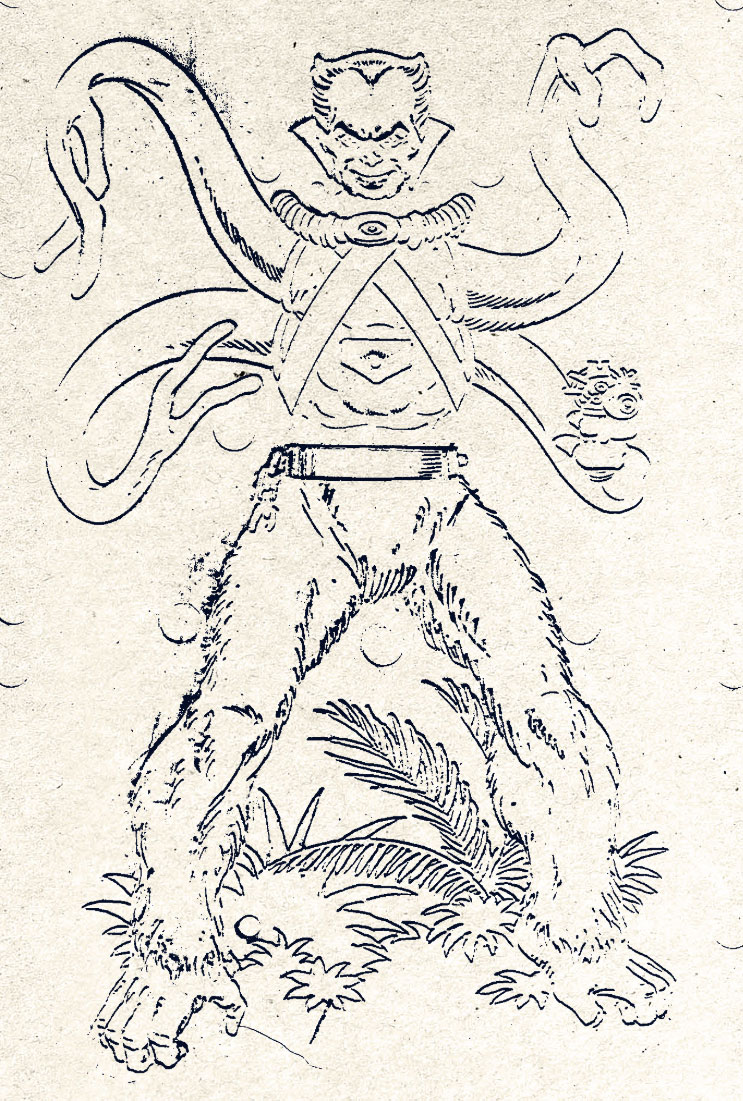
Below the structure is a vast natural cavern with access to an underground river. In this place, Unen has been using the power of the monks' worship to build themself a physical body. No light is allowed down here—the monks collect water in absolute darkness—but all the Brothers who have taken the second set of vows know all about it. It's a titanic, androgynous humanoid figure, its flesh hard as wood and cold as stone. It has four arms, and a smooth lozenge of metal in place of a face. Much of the upper half of the body—from the head to the upper pair of shoulders to the back—is covered in very long, dense hair. The shape is lying down—has been lying down for all the centuries it has grown here—but would be hundreds of feet tall if it stood up. It would also need to destroy the cavern ceiling and the Omphalos above to do that. In the light, its skin would be pale blue, its hair would be deep black, and its metal face would be mottled gold.
The body certainly seems complete, but Unen hasn't seen fit to inhabit it yet. The Brothers don't know what their god intends to do with it, if anything, and officially they don't worry about it.
Well, that one took me forever to do! The ideas are easy enough, but actually writing them up seems to be like pulling teeth. I probably should've just gone with a bullet point format or something.
Also, I'm realizing that I need to figure out some naming conventions for this setting. I like to just use English words most of the time, but some nonsense fantasy words occasionally seem necessary. I've got a rough idea of the languages used in and around the Territories, but I need to give them distinct sounds.
That said, the setting does feel like it works. I'm starting to understand it as its own thing rather than just a collection of references to other works. Definitely needs more development, though, just like I said up top.
You ever wonder if you could do a thing, and then kind of idly figure out a way to do it, and then find yourself compelled to do that thing because now you know it's possible?
I recently went down a path like that, and it led me to making a web page that kinda-sorta simulates the ancient Mighty Men & Monster Maker—kind of a drawing-with-training-wheels toy, and arguably an analog precursor to video game character customization systems.
For a little kid in an era where videogames barely existed, much less character creation screens, this was magical. And, for real, it was probably a big part of why I'm such a sucker for cosmetic DLC these days. Might have something to do with my approach to TTRPGs, even.
Anyway, please check out this dumb, pointless thing I made.
So, the simple damage-reducing armor system I posted last time is the one that I would actually use, the one that I'm probably going to include in that B/X hack I've been messing with, on and off.
However. I'm an admitted simulation sicko, and I've also got another version of that mechanic in mind. It might be too annoying to use at the table due to the small but persistent cognitive load it would add to the already-more-hassle-than-AC armor-as-DR system I proposed previously.
The idea is simple: If the attacker rolls high enough, they bypass the attacker's armor. So, effectively, every armored creature would have two "armor classes": a defense score that an attacker must meet or beat to hit the target and an armor score that an attacker must meet or beat to inflict full damage. If their attack roll falls between those numbers, the target is hit, but their damage reduction is subtracted from the damage they suffer.
The target's defense score would basically be their unarmored AC, probably 10 + Dexterity modifier + shield bonus, etc.. The armor score would be the defense score plus the coverage score of their armor.
The easy way to convert armor to this system is to just give everything a coverage of 10 and a DR equal to its normal AC modifier—double the DR value on my previous system, since it can now be bypassed. And that's the assumption I made when putting together my comparison spreadsheets.
Armor-as-DR experiment v.2.0
I've improved my testing methodology. Instead of rolling 5,000 actual tests and averaging the results, I'm just calculating the average damage in a single formula (and factoring in a double-damage-on-natural-20 crit mechanic). I'm basing my numbers on Old-School Essentials in ascending AC mode. I charted out the expected damage for large ranges of attackers and targets with the standard AC mechanic, my simple armor-as-DR mechanic, and my limited-coverage DR mechanic. (In order to make my life easier, I just gave the targets in the simple DR test 100 armor coverage instead of coding coverage out all together.) Then I compared the results, first comparing AC to armor-as-DR, then comparing AC to the limited-coverage version.
In those comparisons, I'm subtracting the expected damage in the AC system from the expected damage in the variant system. So, a number (and redder cell) means that, in the variant system, more damage would be done in that particular attacker-target pairing. The occasional negative number and slight trace of blue shows where the variant system results in less damage. The green areas are where good old AC and my DR hack produce very similar results.
Interestingly, while both DR systems result in armor being less effective against high-damage attacks, the charts for the sicko version (limited coverage) are a lot smoother and greener than the simple DR mechanic. Which does make me wonder how my gaming group would feel about having to compare every attack roll to two different target numbers.
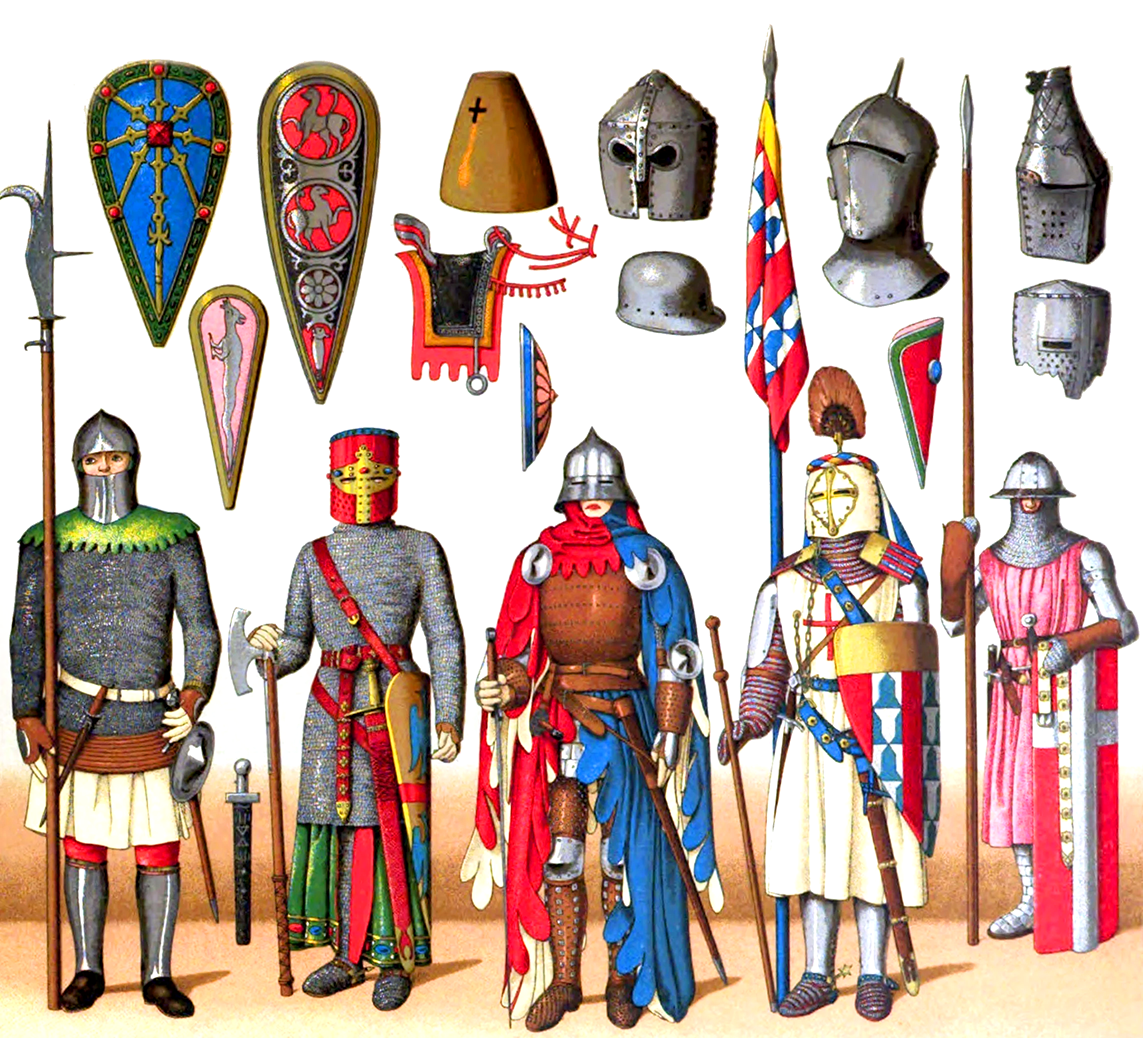
Anyway, the real reason I'm interested in this more complicated armor system is that coverage gives you another fun number to use. Instead of just giving every kind of armor 10 coverage, I could include low-coverage stuff like breastplates and leather jackets. If I wanted to go really sick, I could model piecemeal armor by adding even more armor threshold scores. Damaged armor could lose coverage (which seems more appropriate than losing DR). Helmets could add coverage—I could do a whole post about how helmets are cool and we should think about helmets more!
But yeah, I dunno if I'd really want to inflict this on my friends. I've got a higher complexity tolerance (and more dire simulation perversion) than most folks, and I am very aware of that. For now, this is just thought experiment territory.
Like a lot of folks, I've been thinking for a long time about representing armor in a D&D-like system with a damage reduction mechanic (which decreases the damage done by every successful attack) rather than the usual damage prevention mechanic (which reduces the likelihood of successful attacks). That just feels right to me. It would create a distinction between evading an attack and absorbing it with your armor, and that would let you play with mechanics like armor-ignoring attacks that don't auto hit and unavoidable attacks that are mitigated by armor.
I've frequently heard that this isn't viable. That it would turn combat into a slog of slow attrition.
That sounds like a problem one could solve with spreadsheets! So I set up a bunch of formulas to basically roll attacks and damage for various scenarios in a standard AC paradigm (using Old-School Essentials as my baseline) and output the average damage per attack. Then I tried the same thing with various levels of damage reduction, and I looked for where the average damage in the first paradigm matched the average damage in the other.
The results actually pointed toward an extremely simple conversion: For every 2 points of AC bonus, give the character 1 point of damage reduction. Any AC adjustment from high or low Dexterity can stay, as can bonuses from shields. (This mechanic does still use AC, but I'd just call it "Defense" instead.)
So, if a suit of chainmail gives you AC 14 in an ascending-AC system or AC 5 in a descending-AC system, it gives you DR 2 in this armor-as-DR system. If you've also got a shield and a Dexterity modifier of +1, then your Defense (essentially your AC) is 12.
Here's a whole series of tests demonstrating the overall effects of that change in nine different scenarios. As you can see, damage-reducing armor turns out to be very slightly better for the target than hit-preventing armor as long as we're only considering attacks at the lower end of the damage scale. Once the potential damage gets higher, and we look at stuff like a black dragon's bite or a Thief's backstab, damage reduction starts to fall behind hit prevention.
Overall, I'd expect this change to make fights slightly slower at lower levels and slightly faster at higher levels, which sounds good. I might also allow damage reduction from armor to apply to auto-hit area effects like fireballs and such.
Nine scenarios aren't very many, but this looks good enough to be worth testing out for real. The question is: What kind of testing would be sufficient? Since the real question is how the mechanic would hold up as the numbers get bigger, it kind of demands trials over a wide spread of character levels. Maybe I could do some kind of "You gain a character level every time you reach a deeper dungeon level" thing. It would distort player behavior, but if that leads to more fights, it's probably better for testing anyway.
The excellent Prismatic Wasteland called for a blog bandwagon on the broad and highly relevant topic of maps. Predictably, the first thing I considered was making some kind of map generator. I discarded that idea, considered instead just creating a bunch of actual maps with some kind of mechanical connection . . . but then I went back to the generator idea. So here it is.
Tiny hex map generator
Before I proceed, I need to give credit to Warren of the I Cast Light! blog, whose "Six Hex Crawl" post was a major inspiration here. I also owe a debt to Jed McClure's Wilderness Hexplore Revised.
Okay, so each of the big boxes on the right of the "map" sheet is supposed to be a map hex. No particular scale. The first bullet point shows the prevailing terrain type for the hex, the second shows the main feature of the area—like a dungeon or town or lair—and the third just gives you a couple spark-table-style words to add color to the area. (That third bit does a lot for me; I really love interpreting these oracles, you know?)
Now, you can reload the browser window to reroll the map, but I recommend you make a copy of the file so that you can alter it yourself. Selecting checkboxes and such counts as alteration.
Once you've got your own copy, you can select a terrain type for the center hex, or just leave it as "random". Neighboring hexes influence each other's terrain type, so the center tends to determine the overall character of the map.
You can also select specific features for the map to include. It's one feature per hex, so picking more than seven means those selections get way less certain. Note that most of the options are broad categories, so if you select "resource", that might show up as something like "defensible terrain".
The "megadungeon" feature type is the only one without any variable details. That's because I figure that, if you're going to run a megadungeon, you've already got a pre-existing one in mind.
The map will auto-generate with every click, but you can also just toggle the "click to reroll" checkbox to get a new map without changing any parameters. If you want to save a generated map to another spreadsheet, make sure to do a "paste as values" so that you get the actual results instead of the formulas. (This will fuck up the merged cells, but you'll have the contents.)
I think this would be pretty handy at the beginning of a campaign to just give me a little starting area I could flesh out. If I know I want to run Rappan Athuk but I don't have a surrounding region and convenient nearby town in mind (I have no idea if the book includes that stuff already), I could just generate a few maps with the "megadungeon" feature selected until I've got some something that feels right.
Another use that comes to mind is situations where the PCs find themselves suddenly teleported to a place unconnected to their established starting map. A few years back, I threw a Stargate-style multi-destination gateway into a dungeon, and of course I didn't have maps ready for any of the places the players could have gone with it. This generator could have been real handy there.
A lot of the location features in this generator seem a bit out of place in a water hex, so I'm inclined to presume some coastline to support those castles and dungeons and whatnot. That said, it's also worth asking "Could this be an island or a giant boat or something weird instead?"
If anybody's interested in a verbose description of how this whole thing actually works, catch me on Blewski and let me know. For now, I'll just talk about some ways you could customize this thing.
There are two basic table types in this generator: weighted tables that can potentially produce duplicate results and unweighted tables that prevent duplicates.
This category includes things like the center terrain table and the dungeon table. These pretty much work as described in my random generator spreadsheets post from last year. The "chance" column determines the likelihood of a result, with higher numbers making it more common. The "percentage" column doesn't determine anything; it's just a handy indicator of what the chance column actually works out to in percentage terms. "Min" shows the minimum die roll (so to speak) that will produce a given result, and "max" is, of course, the corresponding maximum roll.
I set up the chance values on the center terrain table to add up to 100, so a chance of 30 makes the "grassland" result come up 30% of the time, but if the chance values totaled 200 instead, then a chance of 30 would only work out to 15%.
Anyway, you can set the chance numbers in a weighted table to anything you want—including zero! They don't have to add up to any particular number. I built my tables so that I could roll on them with real dice, but that's absolutely unnecessary.
On most of these tables, you can change the results to anything you want, and even add or remove entries, but the specific terrain types are kinda hooked into lots of other calculations, as are the basic categories of features. So, if you change "forest" to "jungle", it'll break a bunch of stuff. You can do it, but get ready to track down a bunch of errors.
A lot of the table sheets in here have two sections: the actual table on the left and a sub-generator on the right that rolls on the table a few times, producing results that are used elsewhere in the generator. Maybe that's a little weird or awkward; I just found it convenient at the time.
There are only a few unweighted tables in the generator, including things like the city name table and the color trait table. Instead of working like dice roll tables, these are kind of more like stacks of shuffleable cards. In these, the "index" column contains a bunch of random number generators (using the RAND function, which just spits out a number between 0 and 1 with a lot of decimal places). Then, in the "sorted index" column, a SORT function takes all of those random numbers and sorts them lowest-to-highest. Finally, the column to the right of that does a VLOOKUP on the sorted index back to the first pair of columns, outputting the table's results (city names or whatever) in now-randomized order.
Some other sheet in the generator then looks at the first result on the randomized list, or the first two results, or the first several, and applies that output to some other fields elsewhere. The "field" column on the unweighted tables just labels which results are used, and where.
Anyway, these tables are really easy to customize. You can add, change, or remove results from the B column of the sheet as you please; just make sure that (1) the index column always has a number generator for each entry, (2) the SORT function in the sorted index column covers all of the index cells, and (3) there's a corresponding VLOOKUP formula in the last column for every number in the sorted index column.
Okay, this one's slightly weird. It's a weighted table, but the actual result it's rolling isn't the terrain type, but the rarity. Then some other part of the generator looks at the terrain types of a neighboring hex, and cross-references that terrain type with the randomly rolled rarity to find the new hex's terrain type.
Anyway, you can change the chance values without any trouble, and replace the terrain results as long as you stick to the six existing types. If you don't want water hexes, for example, you can just replace all the water results with grassland or whatever.
You could also add or remove rarity levels, or rename them! They don't even have to be about rarity; I actually had "A, B, C, D, E" in that column at first.
Okay, so let's see what I can actually get out of this thing. First, I'll go full random, with no specified center terrain on required features, then hit the reroll button and take the first map I get.
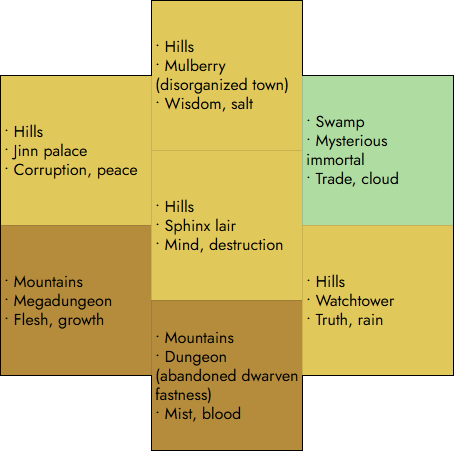
So the terrain seems pretty sensible: We've got an obvious altitude gradient with highlands in the southwest and lowlands in the northeast. Hills-to-swamp is an odd transition, though. I imagine the hilly hexes are moorland, flattening out to a peat bog in the northeast. The mountains are probably green but not forestested. I've got "rain" as a spark word in the southeast hex, but I think it's rainy all over this place.
We've got an abandoned dwarf hold and unidentified megadungeon in the mountains. These might be related! In the north, we've got Mulberry, a "disorganized" town that's surely a natural home base for adventurers. The watchtower might be an outpost of some empire, or it could be some abandoned/haunted place that the PCs will conquer for themselves.
But we've also got some interesting magical folks hanging around here! There's a whole palace full of jinn (whatever that means here), a sphinx lurking in the hills, and some ambiguous immortal chilling in the bog. I'm a big fan of taking folklore-derived creatures as independent beings instead of representatives of their originating stories or cultures, so this would be a fun opportunity to do non-Arabic jinn and a non-Egyptian/Greek sphinx. Not sure what that means yet, though.
Let's start at the top with the town of Mulberry! I figure this place is an informal settlement, a collection of outlaws, refugees, or prospectors. The sparks "wisdom" and "salt" are interesting. I think the people here know something that the rest of the world doesn't. Does the salt indicate that the nearby swamp is a salt marsh (perhaps with a sinister secret) rather than a peat bog? Nah, I think it's metaphorical salt: The people of Mulberry are aggrieved over something. I'd make them refugees from the dwarven fastness, but "Mulberry" isn't a good dwarf town name.
Instead, I want to go with my other two ideas: These folks are both outlaws and prospectors, kinda like what people call "artisanal miners" these days: They're here to harvest resources that they're technically not supposed to touch, specifically loot from the old dwarf hold. They're not dungeon delvers, but they've been hauling away accessible stuff from the surface, from old weapons to stone blocks. Unfortunately, they couldn't settle any closer because they're scared of the sphinx, and the soldiers in the watchtower—who come from the same northern country as most of the people in Mulberry—have orders to prevent their countrymen from offending the greater dwarven community. And that's why they're feeling so salty.
Oh, and I just decided they're mostly halflings. Mulberry is a great name for a halfling town.
I used the term "jinn" without thinking much about how that's not technically a thing in D&D, but of course I mean the beings that various versions of the game call dao, djinn, efreet, marids, and (in some editions) jann. I disagree with D&D's conception of the jinn as elemental beings: It seems pretty clear that they fill the same niche as fairies, so I'd have categorized them as fey.
And that's the role that they'll have here in their castle out on the moors. It's a beautiful, colorful place, seemingly out of place—even inexplicable—in the rough landscape. The people who live here aren't as ephemeral and transcendent as fey who dwell in a hidden otherworld accessible only through a fairy mound, but they're clearly a different folk from mortals: They're tall, powerfully built, and radiantly healthy, with gem-bright eyes and insanely luxurious clothes. They read as humans to the halflings and dwarves of this area, but a human will know there's something really odd about them.
The palace needs a name, so I'll call it Dream in Summer. It's kind of a vacation cottage / refuge from Fairyland political strife. This "vacation" has lasted a very long time. The jinn could go back home at any time, but they'd face uncertain consequences.
These are powerful, magical, immortal people, but they're also kind of earthy and hedonistic. They like to eat and drink and sleep and fuck. They like to fight, too, but they're not allowed to kill anyone here, not even each other: That's part of the rules of whatever treaty is letting them stay here. And they're loath to even fight any mortal, because it would be really easy to kill one accidentally.
They're also loath to do any work, so they've got slaves for that. They've got dwarven slaves from before the fastness fell, they've got halfling slaves from Mulberry, and they've got fairy slaves (mostly goblins) from their home. They take people into their service through gifts and debts and oaths, and hold onto them through magic. The slaves are absolutely able to kill people, but the jinn aren't allowed to directly order them to do that.
When I put "mysterious immortal" in the generator, I was vaguely picturing a Tom Bombadil type, or an old hermit who's secretly a retired celestial. If the immortal is living in a bog, though, that suggests a different vibe. The spark "trade" makes me think they're a mortal who sold their soul for immortality, or a supernatural being who gave up their power to dodge some responsibility.
I think I'll go with the former, since it would make loads of sense for somebody to bargain with the jinn at Dream in Summer for immortality. I also dig the idea of having some kind of Baba Yaga figure here, so I'll say that this immortal is an extremely old dwarven woman, and an ambiguous but intimidating magic-user. Let's call her Grandmother Mirgrim.
She knows all about who the jinn are and why they're here. Maybe they needed her soul to make their refuge here work. She's also kind of a liability to them, and they would prefer if someone killed her. She lives in a muddy little stone hut and flies around at night on a little cloud like Son Goku. The people of Mulberry are afraid of her, but they bring her food and sometimes ask her for help. A halfling kid from the town comes by to do housework for her every couple days, and they're halfway to becoming Mirgrim's apprentice, but not out of the running for being sacrificed in a ritual.
So here's our sphinx. Do you suppose sphinxes, lammasu, and manticores might all be the same kind of being? That's a thought. Not sure if there's room for that idea here, though.
Let's make this a male sphinx, because you basically never see that. I'll ditch the goofy androsphinx/gynosphinx distinction, though. This is just a sphinx who happens to be male. If the jinn are earthly/fey borderline beings, the sphinx is borderline celestial. Maybe this one is in the process of gradually falling to a more earthly state. He's not a manticore, but he could become one.
Running with the idea of sphinxes as divine servants and the sparks "destruction" and "mind", I'm going to say that this guy was involved with the extermination of the dwarven fortress as some kind of celestial retribution and was stationed here to keep it from being reoccupied. And both the guilt and isolation are getting to him. He doesn't technically need to eat, but he's started hunting animals. He hasn't eaten anything sapient yet, but he might.
He speaks all languages and he never lies. There are a lot of things he doesn't want to talk about, so he stays silent most of the time. He's got a name, but he doesn't tell anyone.
He lives in a massive burrow dug right into the moor. It's as clean and perfect as a hole in the ground could possibly be.
This hex contains the megadungeon, but I've been really focused on the abandoned dwarf hold as the defining ruin of the region. This place could just be a larger extension of the same dwarven civilization, or else some older site that was connected to why the dwarves were punished. I like the latter idea better, so I think I'd pick something fairly random, grind off the serial numbers, and put something terrible and world-threatening at the bottom.
The spark words "flesh" and "growth" are great, obviously. Maybe the cataclysmic threat inside it could be some combination of Abhoth, the Thing (from The Thing), and the Stuff (from The Stuff). Maybe throw some extra mimics, doppelgangers, and shoggoths in there.
The watchtower—as established—hosts a military mission from a mostly halfling polity to the north. This region is effectively no-man's land since the dwarven fastness was destroyed and the northerners make no claim to it, but they know that some other dwarf faction will want to reclaim or scavenge the ruins as soon as they can figure out who has the rights to it . . . and how to deal with the sphinx. When some of their own people started venturing south with dreams of prying gold teeth out of dwarven skulls, the halflings decided to head off an international incident and station a few soldiers down here.
The watchtower is also an old dwarven fortification, and has stairs leading deep into the earth, joining tunnels that lead to the fallen fort. The troops keep that door firmly locked.
At the top, there are three swivel-mounted dwarven binocular sets. They're in bad repair, but they still give a pretty great view of the surrounding hexes.
The first troops sent here were an elite team with wizard support, prepared to make a good impression on any dwarven observers or maybe even survive an encounter with the sphinx. Most of those folks have rotated out since, and it looks like the sphinx isn't bothered by the soldiers. The tower is now occupied by some very bored halflings (and a few humans and orcs) who are very sick of the rain and isolation. The only town nearby is Mulberry, and soldiers aren't popular there. It's basically a punishment detail at this point.
The soldiers only know about the palace of Dream in Summer as a bunch of weird human aristocrats who trade with Mulberry. They've been ordered not to go anywhere near the place.
There are notes in the tower's basement that hint at why the fastness was destroyed, but nobody stationed here is both capable of reading Dwarven and interested in old papers.
At last, here's our abandoned dwarven fastness. I found a Dwarf Fortress name generator and got "Cudgelbrass", so I'll go with that.
So, Cudgelbrass was never a full dwarven city. It was something between an archaeological base camp and a tunneling project. It was intended to find and breach the megadungeon in the southwest hex, a place which the founding Dwarves suspected to hold something of tremendous power. Unfortunately, they were totally right, and they succeeded. They were a few miles off target from the actual site, but they persevered for decades—ignoring nightmares and ill omens—and eventually managed to break into one of the older civilization's radiating tunnels.
That's when the sphinx was sent in to destroy Cudgelbrass' alchemical digging engine. The gas released from the apparatus caused more than half the population to hemorrhage catastrophically and die within minutes. The sphinx, unable to lie even to himself, can't say that the genocide was an unintended side effect.
The buried fortress is now wholly empty of living dwarves, but there are a few hideously toxic undead ones down there, as well as alchemical oozes and random subterranean scavengers. There's also also a whole dwarf hold's worth of high-quality weapons and tools, precious metals, and hoarded knowledge . . . as well as a way into the god-forbidden megadungeon.
I'm going to consider each of those hexes to be standard (in some quarters) six-mile hexes. I like handling overland movement in mile-by-mile fashion, so I'll use HexTML to make a zoomed-in map with one-mile hexes.
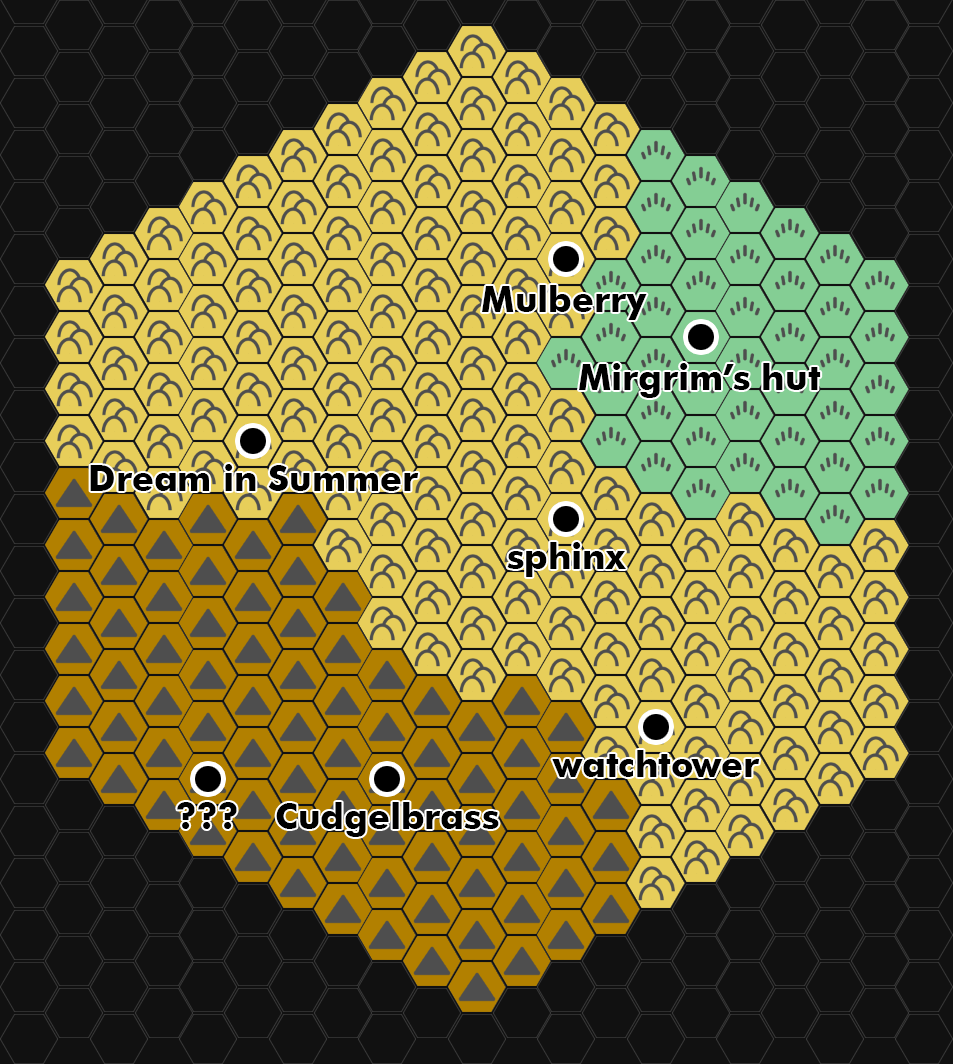
I placed each point of interest within its super-hex randomly, but I like where they ended up, with the town of Mulberry very close to Grandma Mirgrim and the two related dungeons near each other. I ended up labelling all of them in Photoshop instead of just using HexTML.
Anyway, this actually seems like a totally workable start for a campaign! I'm going to call this a successful experiment.
Back on the topic of the map bandwagon, I want to point out a great post on dungeon mapping by Dwiz over at A Knight at the Opera! I'm not sure if it's intended to be part of the bandwagon, but it definitely fits. I'm really interested in the idea of using a flow-chart-style format to make mapping as a playing much easier. Gotta try that out soon.
As I'm sure you're excruciatingly aware, the Internet, its platforms, and the tools we use to access them have been turning to shit for a while now. I've recently taken a few steps to make it a bit better for myself, and they seem to be working out well, so I oughta share them.
One option would be to just switch to a leaner browser that respects your privacy, something like LibreWolf or Vivaldi. That's not necessarily the best option for security (or convenience, for that matter), so you might instead want to customize the browser you've already got.
Just the Browser is a script you can run on a Windows, Mac, or Linux machine to remove unwanted features from Chrome, Edge, and Firefox. Quoting from the Just the Browser site, here are the things it kills.
These changes are configurable and completely reversible. I haven't been using this one long yet, so maybe I'll run into trouble later, but at the moment it all seems great.
We're basically drowning in unwanted "AI" / LLM / machine-learning features and content at the moment. Until the suits get a clue, our best bet for dodging that shit is blocking it the same way we do advertising.
Have you already got uBlock Origin? I believe you need to get the Lite version if you're on Chrome—possibly Safari, too. Anyway, you've probably already got some version of it but, if not, it's much recommended!
Anyway, one of the great things about uBlock is that it lets you add custom blocklists. And Stevo's GenAI Blocklist is purpose-built to clear all those little twinkle icons off your goddamned internet, removing things such as…
Damn, I didn't even know about half that shit, but it's worth adding this blocklist just to clean up Google.
Folks, I don't know about you, but the number of times I've tried to search for something obscure on Google or DuckDuckGo and instead gotten a page full of something much more popular and marketable that's spelled kind of like what I wanted is . . . well, it is a much higher number than I would like.
And the option to search for exactly what you typed ("verbatim search") is still there (at least on Google), but it's kinda buried. It is a multi-click process, and you can't just set it and forget it. You've gotta do it every damn time.
Fortunately, you can just have your browser do it for you.
Here's a very old post from "nostrademons" (on the Y Combinator site of all places) explaining how to do it.
You can't do it for all Google, but if you use Chrome, you can set it as the Omnibox default. Go to Menu -> Settings -> Search -> Manage Search Engines, then add a new row at the bottom that says "Google Verbatim", "verbatim", "https://www.google.com/search?tbs=li:1&q=%s", hit Done and click "Manage Search Engines" again, then find that row in the list above (alphabetical) and click "Make default". Now everything in the address bar uses verbatim search.
And you can set something like this up on Firefox, too. You just go Menu -> Settings -> Search -> Search Shortcuts, add the Google verbatim shortcut, then scroll back up to Default Search Engine to set the new shortcut as your default.
Personally, I use both Adblock and Adblock Plus in addition to uBlock Origin Lite. I have no idea if that's necessary, but it doesn't seem to be a problem.
I've got two extensions just to un-fuck Reddit: Reddit Promoted Ad Blocker and Reddit Image Opener.
I also use No Bloat Fandom and Fandom SideBar Remover, because that wretched platform just keeps gobbling up wikis and showing up in searches, and it absolutely sucks to use.
I ought to check out the Tampermonkey extension (inheritor to Greasemonkey, Chrome-compatible alternative to Violentmonkey). I'm just not ready for that right now.
I should also probably check out Windows10Debloater and privacy.sexy, but I'm a little leery of screwing around with my OS too much.
Oh, and I've been playing around with Linux Mint, and that seems pretty cool so far. But that's way off topic from what was supposed to be a post about Internet stuff.
So, there's hope out there. The stuff that's been bothering you has been bothering other people, and there are some smart folks out there working to address at least some of it. The Internet can still be cool because people want it to be, and the suits still don't get to control everything.
